Five Questions (& Then Some) with Kelly McMasters
2March 24, 2014 by Gaurav Munjal
Welcome to Five Questions (& Then Some), a new interview feature on the site. For this first installment, I requested (read: subjected) my friend and former writing teacher, Kelly McMasters, to answer some of my questions.
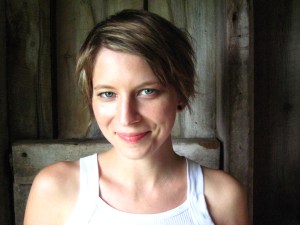
Kelly McMasters
Kelly is a writer, editor, and teacher living in Northeast Pennsylvania. She is the author of Welcome to Shirley: A Memoir from an Atomic Town (available in paperback). She would never call herself an expert on the nonfiction genre, so I will do so on her behalf.
I am delighted to share my conversation with Kelly. You’ll notice there are more than five questions; as a compromise—I realize I’m already compromising during this first interview—I have broken it down into five questions with multiple, moving parts. (And she thought this was going to be a cakewalk…).
1. In Welcome to Shirley, you write about a specific time and place—Shirley, Long Island in the 1970s and 80s. Your memories of growing up there are interspersed with personal accounts and history, creating an engaging hybrid of nonfiction writing. As a nonfiction writer who has written a memoir, what is the role of memory in your writing process and your overall work?
 I find most of my work has a starting place in memory. I usually become interested when something from my current life pings against something from the past—an image, a feeling, or a sensation—and that back-and-forth begins to build a new story. The new informs the old or the old informs the new, and somehow I’m brought to a deeper understanding. When I’m mining memory, I like to go into reporter mode and read old newspaper articles, listen to music from that time, walk in the landscape if possible, dig up photos, and interview other players if there are any. I find it endlessly interesting to discover the ways in which my memory has played tricks on me, mis-remembered something, inflated or deflated an event or excised a person. I like to tackle these mismatches on the page. There’s honesty in that space.
2. What first attracted you to this genre? Did it allow you to do certain things as a writer that perhaps others couldn’t? And now, when you write about certain memories, are you necessarily trying to learn from them?
In college I went to my first reading. It happened to be Terry Tempest Williams reading from her environmental memoir Refuge and my clearest memory from that day is just the way I felt in my body after she finished reading. I felt as though something was humming inside me. It would be years before I would consider myself a writer, but something in my gut recognized what she was doing and responded. I had a similar reaction the first time I read Susan Orlean’s The Orchid Thief. In both books I fell in love with the way these women used themselves as vehicles to tell a larger story. They were the guides, not the center, and that appealed to me. A strictly nonfiction book about orchids wouldn’t have appealed to me in such a personal way, I don’t think, because it was her own obsession I was tracking as a reader.
 Memoir is so gorgeously flexible and can be paired with other genres in order to layer in this personal hand inviting you into the facts. As humans we are naturally drawn to other human stories, which is the power of memoir.
I feel like every act of writing is a kind of learning. I recently heard the historical novelist Julie Otsuka (The Buddha in the Attic) speak and she said (I’m paraphrasing) that all reading and writing is an act of empathy. I write to make sense of events, or other people, or of myself, or all three at once.
3. Every genre seems to have its own pros and cons. In your experience, what are the advantages and limitations of nonfiction writing? As the parameters of nonfiction continue to expand and perhaps get blurred, when does nonfiction start spilling over into fiction?
I don’t see nonfiction as having any limitations at all. There is room in nonfiction for imagination, poetry, meditation, and anything in between. I have an entire section of a constructed scene with a historical character I couldn’t get a hold on because he was such a huckster I had no idea what was true or false. So I started that section with “I imagine” and did just that. My reconstruction was based on research and history, but ultimately it was imagined. It’s all in how you present it to the reader, which leads us to the next part of your question.
 The elusivity of truth is a major topic in my nonfiction classrooms. I don’t like to be too prescriptive, mostly because I think each writer has to draw their own line based on their own personal ethics. Some writers believe in the primacy of the music of a sentence. Other writers put fact before truth. I put the reader above all. With every sentence you are making a pact with your reader. If you lose their trust, you’ve lost them and there’s no getting them back. A writer is nothing without her reader. I think you can do anything you want on a page, so long as you are honest about it with your reader. No one wants to feel betrayed.
4. As someone who spends time reflecting on personal memories and trying to capture them on paper, what have you learned about memory through writing? What is your purpose of exploring memory? What can be gained in this pursuit?
 I’ve learned that memory is tricky, and mushy, and calculating. Memory has its own agenda. This is what I find so fascinating. We are always actively mythologizing ourselves. Memoir, or how I hope to write memoir, works against this and interrogates this impulse, calling memories into question, aiming the flashlight into the dark places, trying to make sense of this automatic ability to protect ourselves that happens in a split second deep in our brains.
 I am reporting out a potential project right now that involves empathy and its place in our lives and memories and also the biological reasons humans think in narrative. Memoir is, at its core, introspection. Only through introspection, and needling our own vulnerabilities and bad choices, do we learn. Cultural histories, collective memory, oral histories—their shared base is story. Even primary sources, the hallowed ground of researchers and journalists, are compromised. We all know who writes history. Humans are complex animals made unreliable by their jealousies and passions. I’ve learned to call everything into question, even the truths I hold closest to me.
5. Finally, if you had to create your own personal canon of favorite literary works, what would it include?
How much space do I have?! I’ll give a short list of literary folks instead, in no particular order: Kathleen Norris, John McPhee, Terry Tempest Williams, Abigail Thomas, EB White, Lydia Millet, Rachel Carson, Wallace Stegner, Jamaica Kincaid, Susanna Antonetta, Tim O’Brien, WG Sebald, Adrian Nicole LeBlanc, Joseph Mitchell, Nabokov, Marilynne Robinson, Mary Oliver.

Kelly’s reviews and essays have appeared in The Paris Review, Newsday, and Time Out New York, among others. She was the Co-Director of the KGB Reading Series in the East Village for five years and also ran Moody Road Studios, a bookshop and reading series in Northeast Pennsylvania.
 The Memory Canon
Very interesting interview; particularly her comment about “biological reasons for why humans think in narrative”. As a non-fiction topic, this would be one I would certainly entertain. The expansion of non-fiction and its continued relationship with truth is fascinating. I wonder what ramifications this has on societal perception of truth; particularly in the legal realm.
Thanks for posting!
Very interesting and insightful interview, made me wonder how much of what we experienced in life we see with objectivity and honestly? Loved what she said about reading and writing as a work of empathy. Thanks for posting.