Breaking Bad: An Appreciation
4October 4, 2013 by Gaurav Munjal
This review contains some spoilers!
After five seasons that produced 62 episodes of glorious television, Breaking Bad finally came to an end this past week. As the credits rolled on the finale of the landmark AMC series, I, like many people, thought to myself: where do I go from here?
Since one of the consequences of new technology is that people consume television at their own rate—I have friends who won’t even begin a season until all the episodes have aired, giving them the opportunity to binge-watch over an entire weekend—I won’t divulge too many details about the ending. Rather, I wish to discuss why this show hit such a nerve with American audiences and, with its final season in the books, should be considered part of the pantheon of great television produced in this country.
I have never experienced a series that was this well orchestrated from start to finish. In the transformation of Walter White from suburban family man diagnosed with cancer to drug kingpin building an empire out of blue crystal meth, nothing felt extraneous; missing an episode would be akin to tearing out a chapter in your favorite novel. So even though the ending became quite clear to viewers over the course of the final season, the conclusion was still riveting to watch. In true creative fashion, the final episode entitled “Felina” was written and directed by the show’s creator, Vince Gilligan. Even if you wished for an alternative ending to the show, you still had to appreciate the fact that the storyteller who began this story was the same one who brought us to its conclusion. We may not have gotten what we wanted, but we certainly got everything we needed. In fact, even the lyrics of the closing song include the phrase, “I guess I got what I deserved,” which rings true for protagonist Walter White and for audiences as well.
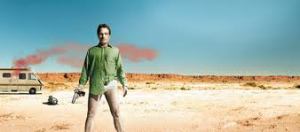 In a single line of dialogue during the final episode, Walter White reaches his moment of catharsis. When his wife Skyler forbids him from blaming the family for his reason to ‘break bad’, Walt finally admits the simple truth: “I did it for me. I liked it. I was good at it. And I was really—I was alive.” When Walt first arrived in our living rooms, he was a milquetoast chemistry teacher lecturing students who had no interest in learning from him. In addition to his cancer, the company he helped establish pushed him out the door and growing financial pains looked like they would crush the family. Surely, his best days were behind him; however, instead of folding, Walt drew upon his knowledge of chemistry—perhaps the only skill set that separated him from the rest of us—and started cooking crystal meth to make a few extra dollars to leave his family. Yet, soon enough, Walt committed himself to the criminal world with the same precision and zeal that he applied to science, and once he started feeling in control over his domain again, he could never return into that hapless man who was wasting his talent in a classroom. The door gradually opened, and after a while, he stopped trying to close it. Becoming a drug lord and building his own empire allowed Walt to reclaim power and, in a way, his humanity. After all, it made him feel “alive” and perhaps even sent his cancer into remission. For a man who learned how to lie all too well, Walt’s admission that he did it for himself instead of his family was the moment of truth to which the entire series has been leading.
 The world of this show gradually expanded over the course of the series. What started out with killing one or two adversaries soon became epic shootouts and a cartel mass murder; even the blue meth drug trade was first a two-man, local operation before it transformed into an international enterprise. Before it became a sweeping gangster saga, it was first an indie-movie obsessed with infinitesimal details—the mechanics of machinery, the chemical compounds in a cook, the way things worked. It was about a small-town man who had just been diagnosed with cancer and was figuring out a way to take care of his family after his impending death—the premise alone explains why this show took so long to catch fire—but really Breaking Bad is a story of America at a particular point in its history. When the show premiered in 2008, the economy was stalling and preparing for the crisis that would later be known as the Great Recession. Many Americans were like Mr. White: down on their luck, living from paycheck to paycheck, and trying to figure out the future before they became its victim. Walt epitomized the new American who felt forgotten by his country, whose skills were somehow no longer required by the turbulent economy. In this way, the character became a type of national reflection; he, like the rest of us, resolved to take back control over his life. So, when he decided to apply his skills to a new profession, albeit a nefarious one, who could really blame him for trying to flip the script?
 Whether by design or sheer happenstance, Breaking Bad tapped into the cultural zeitgeist of the times. In the early seasons, Walt resembled the archetypal American entrepreneur, the scrappy upstart who would do anything to get his product on the market. We aligned ourselves with this character because we saw in him the will to achieve the American Dream on his own terms, and, as a result, we lived vicariously through him. This was enjoyable for awhile, but as the body count multiplied and Walt employed increasingly immortal tactics—poisoning a child comes to mind—our allegiance to him became questionable, and then all together tarnished. Walt eventually became reckless and drunk with power, eliminating anybody who hindered him from building his empire, but more than the money, it was autonomy he craved. He sought to create a legacy that would outlive his time on earth; immortality would be his own victory over cancer and perhaps time itself. And although he was successful in this pursuit with the persona of Heisenberg, the need to be the smartest man in the room also led to his downfall. In the end, Walter White was as complex as the blue meth he created: antihero, tragic figure, American archetype. Many times throughout the series, specifically during the shots of the western landscape, the rocky mountain ranges, and the empty deserts, I was reminded of the notion of Manifest Destiny. Like those early Westerners, Walt came to believe that his success was both justified and inevitable. By glorifying the beautiful scenery of New Mexico, this show not only connected to the great Westerns of cinema but also envisioned a new kind of American pioneer, who, like his predecessors, was in search of his own plot of country.

New Mexico Desert
The setting of New Mexico makes the connections to the Western undeniable, but because of his criminal activity, Walter White should also be considered a gangster. Walt was not an immigrant eager to make his way in America, nor was he a novice who was being groomed into the role. Since nothing was given to him, Walt had to build his own Cosa Nostra from scratch, and resolved on achieving success no matter how many times his progress was foiled. As he transformed from Mr. White to Heisenberg, he became a new breed of criminal, separate from the ones that have become romanticized in gangster pictures, the Godfather movies, or the films of Scorsese. It’s worth pointing out that he never got to spend the money he made, or be as powerful in his own home as he was in his meth lab, or experience any glory that came with his status (even Gus got respect as the head of his own restaurant chain). Here was a criminal who was constantly concerned with covering his tracks, cooking his product, and clutching on to whatever power he had gained, until the point when he had collected too much power for his own good. You wouldn’t think you would root for him, or that he would receive so much fan adulation, but we somehow gave him all our attention, perhaps because the writers were so successful in disseminating the classic gangster tropes into the everyday routine of modern life. In watching Walter White, we see how banal it sometimes is to be the villain. This was not evil percolating in the seedy underbelly of the city, it was hibernating in the suburbs, living in the house next door, cleaning the pool and driving the kids to school. Walt became a villainous mastermind over the course of the show. Perhaps he awoke a dormant force that was lying buried, but he could never change completely. He could never stop feeling for his family, as evidenced by the last few episodes of the series.

Walter White & Heisenberg
Like all great gangsters, Walt enjoyed the mysterious luxury of luck. No matter how foolproof his plans sounded in theory, he was a major benefactor of luck in their execution: from Gus calling off the hit on Walt (those twin assassins still make me nervous), to the magnet successfully destroying the incriminating laptop, to Todd disconnecting the baby monitor in one of the cooking houses (the list is endless). And, in great literary and cinematic tradition, the luck had to run out at some point. Vince Gillian, who directed the last episode, even brought this to the fore as Walt hides in a snow-covered car. The keys drop into his lap in slow motion; the police sirens fade from view. These are essentially the last moments of luck running out for our protagonist.
These touches seemed fated and, as a result, this episode, more than any other before it, took on an air of tragic irony, as if the audience knew the ending before the characters did. And to some extent, we did. The ending that was presented before us had already been etched in stone, perhaps from the very beginning of the show. In the end, Walt couldn’t escape his own master plan; he became a victim to his own ingenuity. Despite all the wrong he had committed, he was still afforded one last chance to step into a lab and survey the precious product he had birthed into the world. At the end of the day, isn’t that what we all crave: to survey our life’s work and leave an impression on the world? (Even if that work is crystal meth and the impression is a bloodied handprint).
.jpg "Vince Gilligan Portrait")
Creator Vince Gilligan
Now, while I loved many moments about the finale, I do have some grievances. My main gripe is that there could have been several more episodes; there was far too much story missing before the finale. For example, we never get to see what happens to the other characters while Walt is hiding out in New Hampshire. After the thrilling “Ozymandias” and the devastating “Granite State”, the writers could have easily inserted one or two more episodes. Even so, all the narrative strands were tied up nicely and neatly by the final episode. In addition, I was hoping for more interaction between White and his partner Jesse Pinkman; they had endured so much together and had become different sides of the same coin. The silent look that they shared at the end was nice, but was a bit unsatisfying. Still, I can understand where Gilligan is coming from; at this point, there is nothing left to say. Perhaps there is more power in silence than in speech. Either way, it will be a look that will have to last a lifetime.
I don’t think the finale reached the levels of such earth-shattering chapters as “Fly”, “Half Measures”/”Full Measure”, “Face Off”, and “Ozymandias”, but it was still exhilarating in its own unique way. Because the ending is always different, the rare bird that must be so many things at once. The episode included the hallmarks of the series: the ingenuity of the machine gun, the unexpected use of the ricin, the heart-wrenching scenes between characters we have come to know so well, and as usual, a few surprises. The ending wasn’t as shocking a conclusion as The Sopranos or as obscure as that of Lost, but like Walt, we got a finale that we deserved. Even when you know what’s coming, the ending can still be devastating.

Westward the Course of Empire Takes Its Way (1860) by Emanuel Leutze
At the beginning of the series, Walt tells his high school class that chemistry is about change. In fact, transformation touched everything about this show: from the characters, to the relentless narrative, and to the viewing public as well. Ultimately, the conclusion was the inevitability of everything leading up to the present. What started out as the show only a few people watched became a pop cultural phenomenon—can’t-miss television that was so good it entered the canon of great American storytelling.
What did you think of series finale “Felina”? Was it a fitting conclusion to the series? And what do you make of the series overall? Does it enter the canon of great pop culture?
 The Memory Canon
Judging by the ratings, the culture finally caught up with Breaking Bad. Due to streaming methods, the public was able to get up to speed with this series. Look at the ratings of the final season, which increased with every episode. Who would have thought that a show that generated 1.9 million viewers in season 2 would go out with 10 million viewers in its finale.
While it helped change television storytelling in what it is today, Breaking Bad also changed the way we consume television. I’m sure AMC executives would have loved to post these kinds of numbers throughout the five seasons, but this series, perhaps more than any other, benefitted from binge-watching. It wasn’t an overnight success. It spread through the culture like a virus, or even a drug addiction to Heisenberg meth. This last season, if I missed an episode, I just avoided my facebook feed to avoid spoilers. The show that nobody was watching became the only thing worth talking about.
We could have used more episodes, but the show still went out on top. Bravo!
I can completely vouch for the post above. I am about to start season 4 on Netflix and I have binge watched the last few weeks just to be apart of the buzz surrounding the series finale. Intense show, incredible acting, can’t wait!
A great read and makes you wonder on human and chemical chemistry and the intertwining of both . Wants needs greed pain and the role of drugs in our society in this day and age . Great read
So excited about Breaking Bad winning the best TV show at the Golden Globes. Well deserved! Even Vince G mentioned the “grimm days when we had very little viewership” during Season 1.