Prisoners: Getting Lost in the Maze, then Getting Out
6September 25, 2013 by Gaurav Munjal
This review contains some spoilers!
To what extent are we prisoners of our own lives? I asked this question of myself upon seeing the new film Prisoners, directed by Denis Villeneuve and starring a boatload of talented actors including Hugh Jackman, Jake Gyllenhaal, Viola Davis, Terrence Howard, Melissa Leo, Paul Dano, and Maria Bello. At the end of the day, are we not all prisoners to our desires and obsessions, our fears and insecurities? While this new release may appear as your standard mystery thriller, it has plenty of questions and concerns percolating underneath its surface that remind audiences of the heights this genre can still achieve.
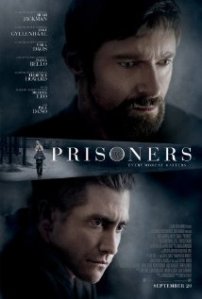
Poster for Prisoners, Image courtesy of imdb.com
The narrative hits the ground running with the sudden disappearance of two small girls—daughters in neighboring families in a Pennsylvania suburb—on the afternoon of Thanksgiving. The parents of the girls are Keller and Grace Dover (Jackman and Bello) and Franklin and Nancy Birch (Howard and Davis); though one is white and the other black, both families belong to the working, middle-class and are meant to embody everyday America. The abduction of both girls immediately ratchets up the stakes, both for the characters as well as the audience, and while a typical revenge tale could possibly unfold, instead we witness a morality play contemplating the extremes to which ordinary people will venture when pushed to the limit. When the life you have built for your family becomes threatened, how far will you go to restore balance in the world?
Keller, a survivalist who takes pride in his ability to protect his family against unforeseen danger, takes matters into his own hands. While all signs of the abduction point to the character of Alex (Dano), a young man with mental difficulties and a voice just a hair above a whisper, the police don’t have enough evidence to keep him in custody. Unwilling to believe anything Alex says, Keller resorts to abducting him, holding him prisoner in an abandoned building, and beating the sense out of him until he confesses to the crime, or at least gives some clues to his daughter’s whereabouts. The casting of Jackman is quite sly here as his acting persona adds another shade of meaning to these proceedings; we may know him as the superhero Wolverine, but here he is presented as the rugged family man who unravels into the kind of criminal from which he always vowed to protect his family. Keller shows us how the moral father who recites a prayer before killing a deer at the beginning can so easily become the violent monster who tortures another human being.

Actor Hugh Jackman (as Wolverine)
The film splits into two paths of justice. On one hand, we follow Keller enact his vengeance. Keller punches Alex until he is unconscious, strangles him and ties him up to the wall, and ultimately, after not getting the information he needs, boards him up in a box smaller than a prison cell. Our shame in witnessing this violence is mirrored in the reactions of the Birch couple, who at first can’t believe what Keller has done, but gradually open up to his reasoning, for they too will do anything to find their missing girl. The other strand of the narrative focuses on the character of Detective Loki (Gyllenhaal), who performs meticulous detective work to find the girls. With no personal background, Loki becomes consumed by the case, tracking down leads, researching previous abduction cases, and running after shady fingers in the night. Just as relentless Keller is in beating the truth out of his victim, so is Loki in applying his acumen to resolving the case. Even though both characters reach the same destination—the opening of the enemy’s lair—they have taken very different paths in getting there.

Actor Jake Gyllenhaal
The film almost enjoys placing the viewer in the position of the parents. If our children were abducted, would we allow the police to run their protocols or would we seek justice on our own terms? While the Birch couple wrestles with guilt over the torture, Keller adheres to the American ways of self-reliance and individualism. If he can’t save his family, then no one can. To what extent can the individual sustain the life that he has created for himself? When we are threatened, how far should we go to protect our families and ourselves? One of the central themes of the movie is the capacity for the individual to be corrupted, which leads to that insistent question: if morality can so easily be corrupted, was it even real in the first place? The parents not only lose their daughters but also their entire worldview; even in their pursuit of justice, they are still dragged down into the depths of their own despair. Through all of this, Detective Loki remains the moral center of the movie, relentless in his pursuit of justice without dipping into criminality.
Even though the action of the movie takes place during a week’s time, the case gradually unearths decades of past abductions, violence, and imprisonment. This is not only a feat of the writing—how two hours of screen time can encapsulate twenty years—but also of direction. We are slowly absorbed into this world, held captive not unlike the characters in the film. In this way, the title of the movie works on multiple levels, for each group is imprisoned by some force haunting over them. ‘Prisoners’ could refer to the girls, who are physically held hostage, to the parents, who are held in an emotional and psychological prison by the abduction and their pursuit of the truth, to Detective Loki, who becomes so enraptured by his cases that he can’t fathom any life for himself outside of work, and perhaps in its most unsettling case, the perpetrators themselves, who as we come to understand, are locked in their own psychological prison after years of being tortured and committing torture themselves.

Justice and Divine Vengeance Pursuing Crime (1808) by Pierre-Paul Prud’hon
What separates this movie from others is not how the child abduction plays out but why this crime has come to pass. We learn that the abduction of these girls is only the latest in a series of abductions that has plagued this town for several decades, which perhaps explains the dreary, gray landscape and also the lack of outside perspective on the events at hand. Save a neighborhood vigil and some newspaper articles, we don’t see how this crime impacts the community, which suggests that it is more common than anyone would like to admit. As one mother explains the situation of the missing girls, “Nothing happened to them. They’re just gone.” In the end, we realize that the people who abducted the girls are themselves abducted children from the past, only they were the ones allowed to survive. They were raised to continue the legacy of their abductors, who over time became their caretakers and even parents. In this way, the obsessions and crimes of the parents are transcribed onto the children, who, even as adults, can’t break free from their imprisonment. This younger generation of criminals maintains the cycle of violence, even perhaps against their own will, infecting the town with its unique sense of dread.
.png "Maze Image") For me, the lasting image of this film is that of the maze. The maze becomes the metaphor for not only the narrative—with its dead-ends, overlapping acting between past and present, and unexplained coincidences—but also for the imprisonment experienced by the characters. Embedded within the narrative is the message that we reap what we sow, that the violence inflicted on others earns some kind of imprisonment in the future. The sins we commit against other people—especially the ones between parent and child, teacher and student—have a way of sticking around and bleeding into the future. And isn’t that true of us as well? We are born into the shadows of our parents, in a way as prisoners to their legacies and expectations (especially if they’re evil). How may of us follow in line? How many of us imagine a life different from the one that has already been imagined for us?
For me, the lasting image of this film is that of the maze. The maze becomes the metaphor for not only the narrative—with its dead-ends, overlapping acting between past and present, and unexplained coincidences—but also for the imprisonment experienced by the characters. Embedded within the narrative is the message that we reap what we sow, that the violence inflicted on others earns some kind of imprisonment in the future. The sins we commit against other people—especially the ones between parent and child, teacher and student—have a way of sticking around and bleeding into the future. And isn’t that true of us as well? We are born into the shadows of our parents, in a way as prisoners to their legacies and expectations (especially if they’re evil). How may of us follow in line? How many of us imagine a life different from the one that has already been imagined for us?
The film does have its faults. For one, it runs a bit too long, but you should decide what works and what doesn’t by seeing it. I can’t help shaking the world that is presented in this movie and how dreary life can sometimes be. In this run-down community that seems stuck in time, the rain pours down constantly and gray snow covers the isolated, bleak landscape. Even though the images smudge together like ink, everyone is on their own, surviving in their own orbit until some inexplicable force comes storming through the front door. Evil seeps through the town, passing from one generation to the next, until somebody close enough manages to stop the leaking.

Christina’s World (1948) by Andrew Wyeth
In the end, we are all trying to make it out of the maze. We are all trying to avoid imprisonment of any kind. But even when we have control over our lives, freedom is never a guarantee.
 The Memory Canon
Excellent review! I’ve been waiting a long time to see this movie and reading this just got me more excited. I like how you pointed out the possible meanings of the title, because when I first started reading this post I just assumed it referred to the two kids.
Well said! I loved this movie — hadn’t really thought about the maze as a metaphor for imprisonment but I think your analysis is spot on.
“But even when we have control over our lives, freedom is never a guarantee.”
That’s a very interesting thought. In theory, I agree that we all are in control of our lives and our respective destinies but it’s hard to define “freedom” in today’s world. Does it mean self-satisfaction in life regardless of one’s financial circumstances? Does it mean wealth and prosperity? Or does it mean something else altogether?
I feel that each day, all of us go to work or school and strive to attain that elusive “freedom” but when will we ever achieve it? The definition of it continues to evolve over time with each experience you go through. People are very much driven by a notion of success and happiness as defined by society which is comprised of constantly changing beliefs as well. I think that has a lot to do with why we feel this “freedom” we are chasing is not guaranteed.
“But even when we have control over our lives, freedom is never a guarantee.”
That’s a very interesting thought. In theory, I agree that we all are in control of our lives and our respective destinies but it’s hard to define “freedom” in today’s world. Does it mean self-satisfaction in life regardless of one’s financial circumstances? Does it mean wealth and prosperity? Or does it mean something else altogether?
I feel that each day, all of us go to work or school and strive to attain that elusive “freedom” but when will we ever achieve it? The definition of it continues to evolve over time with each experience you go through. People are very much driven by a notion of success and happiness as defined by society which is comprised of constantly changing beliefs as well. I think that has a lot to do with why we feel this “freedom” we are chasing is not guaranteed.
Thanks for the thought-provoking response. What is freedom then if we are trapped by all these social boxes, ways of thinking, and expectations? While this film doesn’t go that far, I think it is buried underneath.
Like many things, the idea of freedom changes with time. Our definitions for success and happiness are different at 30 than they were at 20, and as we grow older, we realize that the things we are chasing after are sometimes hollow or don’t live up to the dream.
The notion of freedom keeps evolving because we are evolving ourselves, and therefore, it can never stay in place and remain absolute. Some very interesting ideas come out of this exciting movie! Great response.
I see a lot of interesting posts on your page.
You have to spend a lot of time writing, i know how to save you a lot
of time, there is a tool that creates unique,
google friendly articles in couple of seconds, just type in google
– k2 unlimited content