Lord Shiva, My Glorious Destroyer
2September 24, 2013 by Gaurav Munjal
After writing about the “Abused Goddesses” ad campaign in a previous post, I started thinking about Hindu deities and the mythology surrounding them. Since there are far too many deities to pray to—there are apparently over 300 millions gods in the religion—every family tends to create their own collection of favorite gods and goddesses to worship.
How does one god/goddess get favored over another? It could be the popularity of their mythological tales, or the occasions celebrated in their honor, or even the areas of life that they rule over (wealth, wisdom, health, etc) that determines a deity’s prevalence in the culture. After all, who can resist the genial god Ganesh, to whom we pray at the beginnings of things, or the baby-blue colored Krishna, who as a child was as mischievous as any of us, or Goddess Lakshmi, who blesses all her devotees in the form of candles, firecrackers, and card games during Diwali celebrations.
While I have enjoyed learning about all these deities and their backgrounds, the god that has most captivated me over the years has been Lord Shiva, known as the ‘Destroyer’.
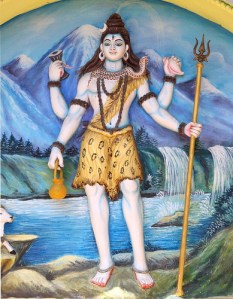
Lord Shiva, One of Many Forms
Even when I don’t invoke his name, Lord Shiva still appears to me in dreams. The deity of destruction—the one figure in the pantheon of Hindu gods that never cohered as I learned the mythology as a child—descends upon my family’s house and floats in between our hallways. I imagine this god hovering over my restless body and bathing my eyes, half-blind and half-waking, in bluish streams of haze. I can’t decipher if I have conjured him within my room in America or if he has found me in hiding away from the homeland. Either way, I fear that he has come to claim me as part of his reckoning.
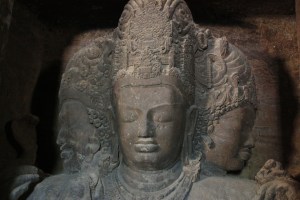
The Hindu Holy Trinity
After lords Brahma and Vishnu, Shiva completes the holy triumvirate of deities in Hinduism. In contrast to Brahma, the creator, and Vishnu, the sustainer, Shiva represents destruction and completion. My mother would always vow that his destructive powers were used for benevolent purposes, such as eradicating evil in the world or relieving the human body of disease, but the image from his mythology that has latched onto my memory the deepest and the first one to resurface is that of Shiva as an angel of death: wearing a garland of skulls around his neck, serving as the lord of the cremation grounds, and swimming in long black tresses of hair that, according to legend, support the holy Ganges River. And though this river purifies all those who enter with its divine properties, it is also the same water in which we disperse the ashes of the dead.
According to mythology, Lord Shiva’s spiritual ancestor, Rudra, comprised an even clearer picture of ambiguity, symbolizing both benevolent and malevolent forces of the world. However, over time, the dark forces within him prevailed, and it is this cosmic dance between good and evil bestowed upon Shiva that has always marked him in my mind. In depictions of the deity, Shiva is painted with a blue, wheatish complexion—the Indian version of cherubic—but some of these images include a bruised discoloration around the neck to signify the poison he ingested upon the churning of the oceans.

Shiva in Nataraja Dancing Form
The duality extends to his most popular representation as Shiva Nataraja, in which he stands in an exquisite pose of dance with one leg suspended in the air and the other destroying a villainous dwarf. As a child, I often wondered how Shiva could be portrayed in two separate but equal forms: one as the deity holding a trident spear and carrying a snake around his neck, and the other one, dancing into the night and appearing more female than male with earrings and anklet jewelry, feminine hand gestures, and a majestic crown atop hair blowing in all different directions. But, somehow, these visions were both of Shiva. He could change between his identities from one moment to the next, which naturally made him more intriguing than the other gods in the pantheon but also more problematic.
“But why do we pray to a god of destruction?” I used to bother my mother.
Because destruction is necessary too, she would try to explain. It is as necessary as life. For he destroys in order to create, tearing down to build again.

Shiva in a Fearsome Form
I could never grasp how Shiva was also the father of Ganesh. If the son embodies the hope and anticipation for the future, then the father must represent the end of the past, the death of it. Is that how it’s supposed to work in real life as well? At the same time, Shiva is known as the quintessential guru, the spiritual guide for seekers of truth, and finds his home in the Kailas Mountain range in Tibet. Shiva’s presence remains elusive, shifting over me so that it can never be wrestled down into a single entity. He has the capacity to be everything at once, and then nothing in the end.
Soon, we will all be destroyed—I remember thinking this as I recited prayers in front of his image on my mother’s altar. I would pray out of fear that if I didn’t pray, he would unleash his wrath upon us; yet, at the same time, I would pray for his protection over our home. That when the mood struck him, he would remember us in America, stretch his hand from the mountain tops, and place it on our roof to offer his blessings.
That’s not how it works, my mother would instruct me. If he is never lost to you, then you are never lost unto him.
Even now, as I try to sleep, I envision his face floating above me in a sea of thick black hair, and the snake around his neck hissing to dare me to open my eyes, and his arms cradling the elephant child that heralds a new beginning after his ruination. All of his aspects clash and battle within, good and evil enmeshed in each other.

Shiva shown with Wife Parvati, Sons Ganesh and Kartikeya
It is believed that Shiva has three eyes, with the third one lying in the powerful chakra area between the eyebrows. When man meditates, he attempts to focus his positive energy on this part of the body to better attain enlightenment. We strive to keep this eye as open as possible, at all times, as opposed to Shiva, whose third eye opens only at the time of destruction.
 As the morning light breaks through and shines on my face, my eyes creak open in response. I wonder if the spiritual wisdom I have gained in practicing the religion and reciting the prayers is enough to crack open that third eye, but if I have to ask, then the portal remains bolted shut in all likelihood. When it does open at some point in the future, I imagine that Shiva and I will have something in common, that he will see himself in me and I may finally see myself in him. I just can’t tell if the light streaming from the vortex at the center of my forehead will signal his destruction or his blessing. Perhaps, like many other things, the extremes of his identity will arrive fused together—the joy and tragedy, the destruction and transcendence, the oblivion and immortality—and appear before me as one and the same.
Either way, I sense that I am standing at the brink and when I least expect it, my third eye will open on its own accord. I suppose, in that very moment, that the Shiva above me will reciprocate by opening his as well.
 The Memory Canon
Very creative exploration of Lord Shiva. Even though he is worshipped as one of the most important gods, we often forget that his background is quite complicated and textured. And yes, I think it is important to point out that while he, as the father, is known for his destruction, his son, Ganesh, represents new beginnings. There’s a lot of commonality with the Greek pantheon of gods, which just goes to show you that cultures are often more alike than different.
Great read ! Love the take on 2 forms of shiva very differently perceived visually . The third eye of wisdom and power and the fact that destruction is necessary and end and death are important cycles of life to promote growth and change .