Abused Goddesses
3September 16, 2013 by Gaurav Munjal
It has been reported this week that the four men convicted of raping the young woman on a Delhi bus last December have been sentenced to death by hanging. While I expect this sentence will satisfy many in the near-term, I hope it doesn’t stall the progress on the social issues that have arisen from this event, particularly domestic violence and women’s rights and equality. Especially since all of these currents can be found in the shocking new ad campaign entitled “Abused Goddesses”, which serves as a barometer of the upheaval sweeping through the subcontinent.
Traditional Images of Goddesses Lakshmi, Saraswati, and Durga: 


Commissioned by Save Our Sisters, an initiative of Save the Children India, and created by Mumbai-based advertising agency Taproot India, the “Abused Goddesses” campaign shows the images of Goddesses Lakshmi, Saraswati, and Durga as victims of domestic violence. While we are used to seeing these deities depicted with pleasant smiles and pristine, glowing skin, the goddesses presented here have cuts and bruises, their faces filled with fear and doubt. “Pray that we never see this day,” the ad reads, “Today, more than 68% of women in India are victims of domestic violence. Tomorrow, it seems like no woman shall be spared. Not even the ones we pray to.” That statistic is staggering but perhaps more shocking are the accompanying visuals, especially given the fact that in the past disfigurements of any kind to Hindu iconography have caused riots in the streets of India.
Abused Lakshmi:
 On the surface, the ads are drawing attention to violence against women by defacing the images of goddesses worshipped throughout the global Hindu community. But the genius of the image is the way it taps into Hindu philosophy, particularly the goal of seeing ourselves in the divine, and then seeing the divine in us. Abusing young girls and women is akin to abusing the goddesses we worship in our homes and our temples. In addition, while Hinduism possesses a rich mythological tradition in which gods battle against demons and wield weapons to eradicate evil, rarely are the deities depicted as bruised or injured. Therefore, to see the goddesses physically harmed in bold, colorful portraits yields not only powerful juxtaposition but also useful introspection.
 I have grown up worshipping the Goddesses Lakshmi, Saraswati, and Durga by praying to their pictures and statues in my childhood home. My sisters and I prayed to Lakshmi, the goddess of wealth and prosperity, especially on the night of Diwali, when I imagined her soaring over us and blessing all the households with candles lit in her honor. As the goddess of learning, knowledge, and education, Saraswati was invoked in our household any time one of us was preparing for an exam. And Durga, who perhaps is considered the most powerful of goddesses and earns reverence in her own right throughout the year, was appealed to every time we required strength or courage. In Durga’s honor, fathers often bathe the feet of their young daughters to invite blessings upon the household, for it is a common belief that little girls are embodiments of the goddesses on earth. That is until they reach the age of puberty, for soon after, the ritual of bathing feet is no longer practiced.
My parents, who have practiced Hinduism since their infancy and raised us in the religion as well, taught their daughters to embody the ideals of these goddesses. I was told to protect my sisters at every turn, for their love would bless me throughout my life. The recollections spurred on by these images made me wonder: how can an Indian culture worship hundreds (even thousands) of female deities and elevate young girls and also commit violence against women at such high frequency? Why is the scope of female purity so limited, evaporating as soon as a girl reaches menstruation? If that percentage of Indian men can abuse women and also appeal to these goddesses, there is a major disconnect between prayer and action.
It has always been my understanding that the reason Hinduism has such a strong mythological tradition is that we can read the stories of the gods, learn from their actions, and embody their sprits in everyday life. One doesn’t have to believe that these stories actually took place but to grasp the morality embedded within the narrative and strive for some type of perfection in real life. I have come to the realization that ritual has no value if there is no understanding behind it and that worship can only get you so far unless it’s translated into action. If we can’t practice what we preach, then what are we praying for? What good is religious belief if it can’t be practiced on earth, in real time, with family and friends, neighbors and strangers?

Abused Durga, Images from Forum for Hindu Awakening
There are critics who will point fingers to explain this violence. They will point to the religion and certain passages of text, but that wouldn’t take into account the religion’s stance on ethical conduct and non-violence. They will point to the culture and the specter of sati (a widow sacrificing herself on her husband’s funeral pyre), the conservative roles of wife and mother in the household, and the deep-rooted outlook that daughters require some form of dowry and that once they marry they are no longer considered part of the original household but that of the husband’s. And there may be some truth in all these points. Perhaps this culture of violence stems from an urge to keep women as second-tier citizens in society, especially as more and more girls become educated, start earning income, and even become household breadwinners. While there is much work to be done in fully uncovering this issue and improving the lives of both men and women, these images serve as a valuable start.
The way in which deities are depicted is extremely important for Hindus. The general inclination is to see the divine in the world around us; thus, to violate the images of the goddesses, albeit for a noble cause, goes at the heart of Hindu humanity. I gather that what we are seeing take place in these protests, marches, and national dialogues is a large contingent of people dragging part of an antiquated culture into the modern age. I think the rape and death of this woman, who was once a little girl whose feet were bathed because of her likeness to Goddess Durga, has been and will continue to be a breaking point. This event has not only captured the public’s imagination, but I venture it has entered a sort of collective Memory Canon. Sometimes it takes tragedy to confront the ghosts of the past and bring about real progress.
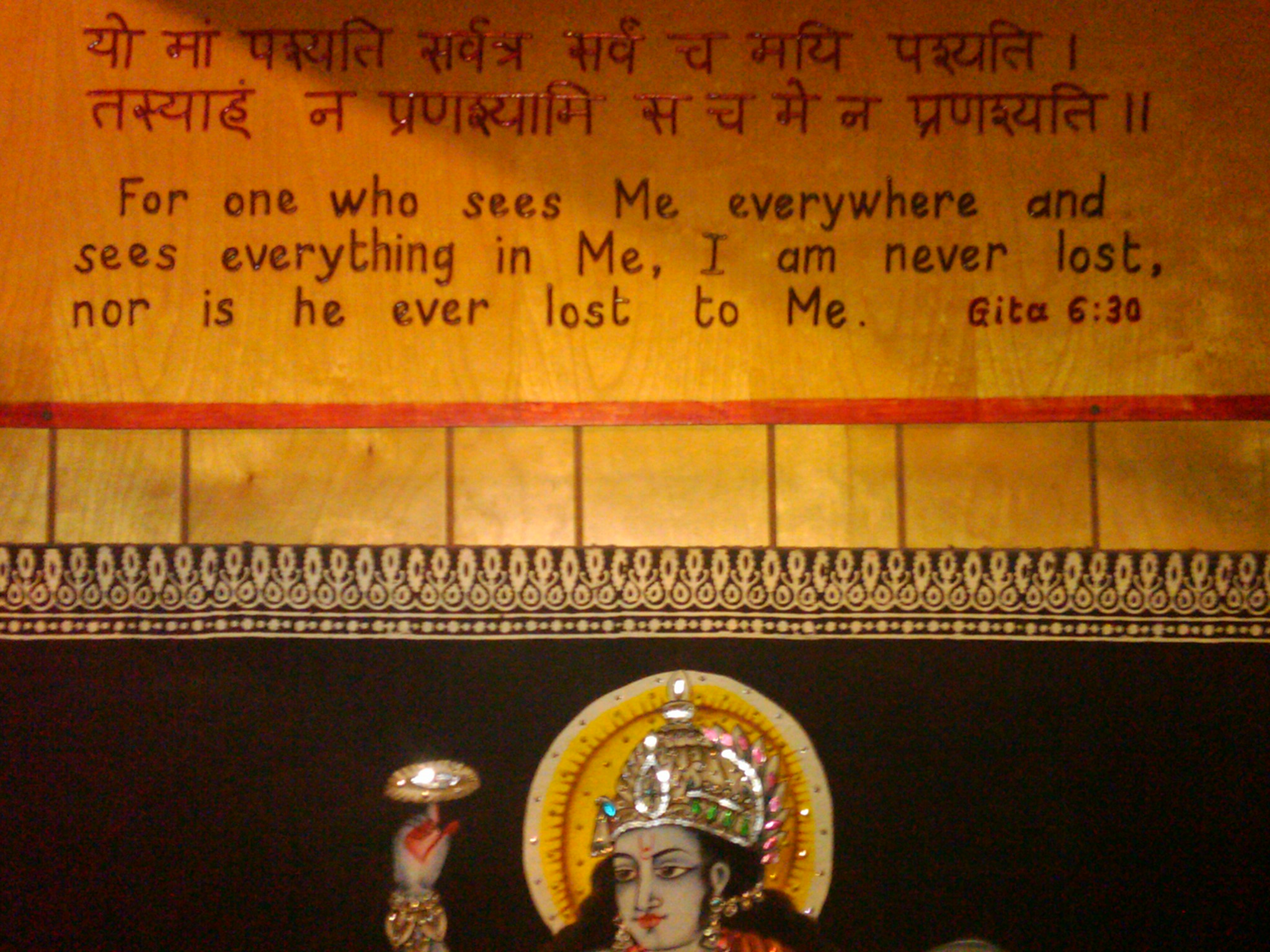
A Popular Hindu Verse
So, what do you make of these images? Are they effective at demonstrating the situation in India? Do the images have any adverse effect on the representation of Hinduism to the rest of the world? How long do you think these issues will remain at the forefront of public consciousness?
 The Memory Canon
These images are definitely disturbing, but I feel they are succeeding in getting their message across despite how controversial they may be to Hindus. Hopefully the effect of this advertisement and the controversy it will be surrounded with will have a lasting impact on the society.
Well written article! Largely, it really articulates the contradictions that exist between the spirituality basis of Hinduism and actual practice. It makes you wonder when or why these practices were created and how they impact the gender divide that is not a problem for just Indians based in India. Anecdotally on the ad campaign, I saw many US-based friends post this on Facebook, but I heard nothing from those actually in India. I understand that the cultural issues are truly global, but did this even generate response in India? I’m very curious…
This article is very thought provoking and addresses the question about female empowerment in India and also globally around the world. This issue seems to get worse in modern age ! It further questions the role of corrupt law authorities playing a large role in this .