Mad Men: One Last Ride on the Carousel
Leave a commentJune 22, 2015 by Gaurav Munjal
I have delayed writing this retrospective on Mad Men partly because I wanted to fully digest the ending, but mostly because of my reluctance to say goodbye to this show. Needless to say, this entry contains spoilers! (If you haven’t finished by now, what are you waiting for?)
At the beginning of this final season, Ted Chaough tells Don that there are three women in every man’s life. And this statement rings true as Don has ‘person-to-person’ calls, the method of calling which gives the series finale its title, with the three most important women in his life: Sally, Betty, and Peggy. They all provide glimpses of the things Don has left behind, essentially the ‘life not lived’ that Ken Cosgrove alluded to upon his firing from SCDP. Speaking of bookends, the notion of the ‘life not lived’ turns out to be the narrative engine for these last seven episodes.
 So much of Mad Men’s finale can be seen as archetypal: it stands as its own unique episode, but manages to bring all the themes of this show into shining focus. I was expecting a sentimental version of Don’s carousel speech, a journey down memory lane or even an imagining of the future, but I received everything I needed from this episode, and then some. The “Person to Person” title is so apt: not only does Don connect with the three women of his life, he also receives encouragement from a tertiary character, Stephanie, and a complete stranger, Leonard, allowing everything to slide into place for our protagonist.
In the end, Don reaches his catharsis, or as close to a cathartic moment we have seen in this series, through the story of a complete stranger. Now looking back, I am quite pleased that Don wasn’t the one to speak during the therapy session and spill all his guts; the scene was more potent because Leonard was a stranger, to both Don and the audience. His revelation of love must have articulated a sentiment of these more conservative times, but like much of this show, it proves to be universal as so much of it still resonates today. Leonard’s dream, in which he feels trapped in a fridge surrounded by darkness, includes imagery as powerful as anything this show has ever produced. Leonard almost describes himself as a product–perhaps a carton of milk, or a can of beer–one that Don and Peggy could sell to customers. However, we realize that this product is hollow because Leonard doesn’t know how to receive love. He can’t even recognize it.

Matthew Weiner
For me, the major ending of the show came in “Lost Horizon” with the shutting of the office and the dissolution of SCDP. The final two episodes, “The Milk and Honey Route” and “Person to Person”, have felt like an epilogue, portraying Don at perhaps his truest self: the Hobo. Don has always relished the ‘beginnings of things’, and whenever a situation becomes too intimate, threatening to expose his identity, he is back on the prowl, essentially on the run. This time, he travels all the way to California, and not via the swanky airlines we have seen in previous episodes, but in a car, meandering through the heart of the country. Matthew Weiner, the creator of the series, has maintained that Don’s story mirrors that of America. And here, near the very end, we get to see this America: we encounter the small towns, the endless roads, and especially the people to whom Don has been peddling all his products and stories over the years. As Conrad Hilton once told us: “America is wherever we look, wherever we’re going to be.”
“Person to Person” starts with Don zipping across the horizon in a car. This image exemplifies his running across the country, shedding pieces of his past and trying to escape all the existential demons of his life. His travels bring him to the farthest West anyone can go, the last bit of America before the Pacific, beautifully rendered in the landscape shots and the setting sun. When the new day rises, the meditation leader tells his disciples, all seated in lotus position, that the new day means “new ideas, a new you.” Don can no longer run, he has come face to face with reality, or person to person with his own creation: Don to Dick (the episode title works on so many levels!). I originally thought Don was trying to shed everything–the money, the apartment, the quintessential suit, everything of material possession–to strip the artifice of Don Draper and finally embrace his true identity of Dick Whitman. Yet, in fact, when the bell rings, signaling the birth of the Coke ad, he can’t escape the truth that he IS Don Draper. The artifice is the reality: he is his own making.
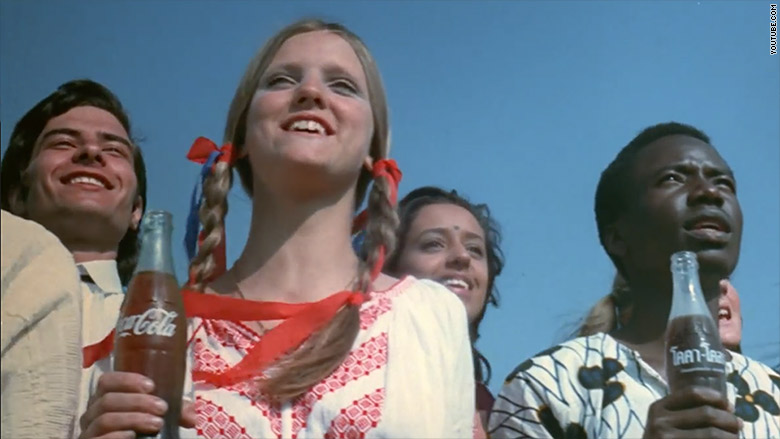
The advertisement’s profession of “It’s the Real Thing” captures so many of the show’s themes that I wonder if Weiner always intended for the series to end this way. The joy you get from Coke may be fleeting, in fact it’s not even joy merely bubbles, but the emotions required to create that falsehood, all the turmoil that Don endured to produce the commercial, that is all REAL. Cynics may point to how obvious and manipulative the commercial is, but even after several decades, it still has the power to produce joy. In fact, isn’t the reaction to Don’s catharsis/commercial a commentary on all of advertising? That sometimes the ads that best reflect the human condition and elicit the strongest emotional reaction often produce the largest profit for the products they are selling. In addition to exploring the lives of its characters, this show has deftly wrestled with the moral complexities of art and commerce.
 I was completely awestruck by the women of this show, and believe that Weiner provided them with glorious endings. While Peggy flirts with the idea of joining Joan in business, she knows that deep down she belongs in advertising. Before Weiner confirmed that it was Don who created the Coke ad, I had an inkling that perhaps Peggy was the one who wrote the actual copy. If you recall, this is exactly how Season 7 began with Don feeding an advertisement for watches to Peggy through Freddy Rumsen. In the future, Don doesn’t necessarily have to remain in New York; he simply needs an outlet to unleash his creativity, and Peggy has always been an outlet for him.
 Speaking of the end, the way Stan approached Peggy while she sits at her desk illustrates a complete role reversal between the genders. We have seen the image of a man working at his desk and a woman offering encouragement from behind; but now, it is Peggy who sits at the desk and Stan, comfortable in his own skin, provides support and love. This image encapsulates how much the times have changed, from 1959 to 1970, and I completely buy into Peggy’s happy ending: where else was she going to find someone compatible? She was more at home in the office than at her apartment building. Of course she was going to find love with a coworker.
Now looking back, we can see how Don created the famous commercial. The signs were there in the imagery of the retreat, the woman in pigtails tied in red ribbon, Jim Hobart’s mention of Coke as ‘advertising heaven’, the broken Coke machine in the small town, and the fact that Peggy reminds Don that he can still work on Coke but only if he returns home. Weiner was parsing out the hints, showing us that Coke was still running through Don’s mind. He can’t seem to turn the advertising off! (And do you remember, during Don’s stay at the motel, he stumbles upon a beautiful woman tanning beside the pool. At the time, I didn’t understand the slow camera pan on the woman, but it was Don seeing her as a thing of beauty, essentially an advertisement. He just can’t help himself).
 Joan’s decision to start her own business was genius and completely in line with her character’s progression. Since the beginning, she has been the professional entrusted to take care of the operations that none of the male characters have any interest in handling. If you recall, Joan was the one who helped the team steal all the necessary office materials from the old Sterling Cooper in the establishment of the new SCDP, and it was Joan who managed the firm’s expansion onto the second level. But on the other hand, Joan has always been searching for legitimacy, trying to carve out her own credibility. Her professional prowess was constantly overshadowed by her sexuality. Before the finale, I was on the right track in thinking that Joan and Peggy would join forces to create a new ad agency (which, again, is really the American narrative: the story of explorers and entrepreneurs who wish to create life on their own terms), but alas, this was not meant to be. The fact that Joan uses both her maiden name (Holloway) and married name (Harris) was confusing at first, but then I realized that Joan is probably referring to her son, and as she informs us, you need two names to be taken seriously (again, names have so much significance on this show). Needless to say, I would trust Joan with my life.
One of my favorite moments from these last few episodes is Don’s lecture to Sally at the bus station. During “The Forecast”, Don reminds his only daughter that she is a continuation of her parents but she still must stand on her own. We have seen little Sally grow up right before our eyes, both literally and figuratively. Instead of fleeing from the hearth like her father, Sally returns home to take care of her two brothers, her stepfather Henry, and of course Betty, the mother she has almost always despised but now will have to bury.
 Betty proves to be defiant until the end, sipping on cigarettes while battling lung cancer. I think Betty has consistently been seen as a weak character, one who has had to conform to the men in her life, but in the end, she chooses not to fight. This is her decision, her pivotal, life-changing (or rather, life-ending) act of agency. There are several explanations as to why Betty is the one to die, one being a commentary on the randomness of life, the other being that Betty has almost always had a cigarette in her hands. As one of my friends pointed out, it’s hard to do a show about the 60s without bringing to light the connection between smoking and lung cancer. In fact, the pilot includes a female researcher discussing the health concerns and labels of cigarettes; we can see the role of cigarettes change over the course of the decade, especially through the narrative of Lucky Strike and Don’s anti-smoking letter. When Sally reads her mother’s letter containing the instructions for her burial, it becomes clear that Betty is most concerned with her final appearance. Some people are not meant to deteriorate in old age; there are some who die young, their memory preserved at the height of their beauty.
People have been interpreting the finale different ways: seeing it through the opposing lenses of optimism and cynicism. One could read Don’s smile as true inner peace, that finally, with the chime of the bell, a new person has been born, the sun radiating on his face. Or, one could interpret the end as Don always selling. He is the consummate Ad Man who will sample real emotions and package them into a beautiful, inspiring commercial to sell soda. Like all things in this show, the answer lies somewhere in between. Weiner has never written in absolutes, the truth is always buried in the middle, in ambiguity, which is a true reflection of the human condition. Only the best of art can achieve this.
 I do believe, however, that Don returned to New York as a changed man. For all we know, after a couple of years, he could reach another breaking point and go on the run again, embracing his Hobo roots. But when he reaches bottom, he will be saved by his own creative genius. This character trait was mentioned by several characters in the finale: Roger, Stan and Peggy all know that he disappears from time to time, but he always returns home. They recognize Don’s pattern of behavior better than he does, because even though the shimmering coastline of California will always appeal to him, once he gets there, he realizes he must turn back. On the very edge of the country, he gets his best ad idea ever. But it is only real if he goes home.
 I truly appreciate how Weiner resolved so many themes and situations but also left the series open-ended. He gives us enough resolution and enough rope to continue imagining the lives of these characters. We not only have the chance to envision the future, but we also get nice callbacks to classic Mad Men tropes: Don racing and working on cars, Don treating the woman he is sleeping with like a prostitute, Anna’s ring as the only connection to that part of the past (his only family heirloom in a way), and the dialogue used to convince Stephanie that she can always move on, she can always move forward (the same dialogue he used to convince Peggy to give up her baby and continue life on her own terms). But we know this last part to be untrue; one cannot simply move on. For we have seen the cost of such emotional baggage play out over the decade.
Up until the last two minutes of the show, I perceived Don as a symbol of his era who would become a relic in the new decade of the 1970s. But really, with the Coke ad, he turns out to be a chameleon who can adapt to his changing surroundings, a phoenix perpetually rising from the ashes. Essentially, Don can reinvent himself generation after generation, which of course, is the American narrative. I am completely amazed by the transformation in totality, from Don sitting in a bar and lighting up a Lucky Strike cigarette in the pilot to him sitting in lotus position and chanting “Om” in the finale. “Om” carries very sacred meaning in Hinduism: it is considered the first sound, and therefore, it serves as the start of so many prayers and chants. “Om” is an invocation to the cosmos, to the gods, and also to the self. An eternal sound. For Weiner to make such a spiritual leap, not only to reflect the times but also to illuminate the growth of the character, is fascinating. And I don’t consider it a coincidence that we have spent the start of every episode looking at Don from behind, the silhouette of his head turned away from us in the credits, to the last image of the series being a close-up of his face. Our protagonist is finally facing us, no longer hiding.

I can imagine how much emphasis was placed on the finale, somehow it had the impossible task of wrapping up such a layered and multi-faceted series. While I was always entranced by the mystery of Don Draper and how his story would end, really, it has been about the journey, not the destination. At the heart of Leonard’s monologue is the notion of human connection: to love and be loved in return. After following this series from the first episode, I have come to believe that Weiner is more an optimist than a pessimist. He likes to dip his toe in that pond once in a while, dwelling in the dark places of humanity, but he always manages to return to the light. The essence of “Person to Person” is that of human connection, which is something that so resonates with my own life. My father, whose story of American immigration is shared by so many, has always trusted in the goodness of people, the kindness of strangers, and the connection between one another. All this and more nurtured my own family’s American narrative.
These sentiments are completely opposite from the Don Draper we met in the pilot. Behold, all the themes that came to fruition in the finale had been planted almost a decade ago in the first episode. When Don meets Rachel Menken for drinks to apologize to her, he tells her that love doesn’t exist. That it has been invented by men like him, Mad Men to be precise. However, in actuality, as this series has played out, it has become apparent that Don didn’t know what love was. He couldn’t even recognize it.
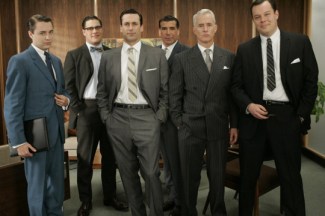
The essence of the show can be found in its roots, in the very name of our protagonist, Donald Draper. Donald, or rather Don, is someone we know. The all-American man in whom we can place our trust. But the last name of Draper has always intrigued me, for what does ‘drape-r’ really mean? When something is draped, it is meant to be beautiful: to portray the illusion of effortless grace. But the name also carries the sense of concealment, of covering up through the distraction of beauty. And this is what Don has been doing since the beginning: making things beautiful through his advertisements but also concealing himself at the same time. He has buried himself in his products, which again makes the final shot of his face so poignant. The truth, it turns out, is a commercial, but it is also a home furnished with love. This…is the real thing!
When I first tuned into this show, I thought it would be kitschy, a show about advertising in the 1960s, but I became engrossed by its depiction of the decade. This is also the time before my parents arrived in America from India, so the 60s have always held some mythical aura in my mind. I believe Mad Men will stand the test of time, this generation’s Great American Novel (perhaps even the one that Ken Cosgrove will eventually write) that just so happens to be playing out on television. It’s something to marvel that a decade in the lives of these characters has transpired in nearly the same time frame in our own. Like the show, everything has to come to an end, but even if we start singing “Is That All There Is?”, then I guess we will just keep dancing.

 The Memory Canon