Like a Prayer
2January 31, 2014 by Gaurav Munjal
My aunt arranges her small figurines of Hindu deities on the coffee table in the center of the living room. The table is covered in a gold, silk cloth with detailed embroidery and tasseled fringe. Since Diwali is a celebration of light, every lamp and sconce is turned on, Christmas lights wrap around the room like flower garlands, and scented candles flicker in the corners of the house.
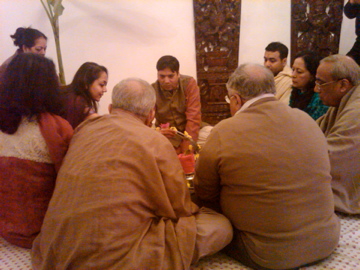 My aunt and uncle, their three children and I kneel to the ground and lock our legs into lotus position. Tina, the youngest daughter, plays a cassette tape of bhajans, Indian prayer songs, and my aunt begins ringing her bell to initiate the ceremony. We all press our hands together in accordance with Namaste, a respectful greeting to the divine.
The cassette tape, a family relic that has been traded from one immigrant to the next and copied for friends to teach their children, starts to skip. The prayer becomes garbled. The singer’s bittersweet voice disappears as the tape spools out of the player. Nobody has bothered to update to compact disc let alone gone digital. My aunt quickly removes the tape and tosses it at her daughter.
“Baby, what is this crap?” This coming from a woman with a scarf wrapped around her head, deep in prayer, and on the verge of tears from memories of old Diwali celebrations. My aunt calls her ‘Baby’ because she is the youngest in this family, and when she causes missteps such as this, she is treated as such.
 Without missing a beat, my aunt and uncle pick up exactly where they left off in the song, and with no hesitation, my cousins join in as well. They seamlessly enter the stream of the song, reproducing the same pitch and tempo as their parents and recalling the complicated vocabulary and sentence structure of the verses, much to my surprise. Even though these cousins are slightly older than me, we are still considered part of the same generation, and without any assistance from a cassette tape or lyrics sheet, they are able to breathe life into the Hindi as if they recently immigrated to America and are looking for visa sponsorship.
For this particular prayer, I know very little besides the chorus. Even then, my knowledge only extends to the Hindi vocabulary and not necessarily the specific translation of each word. After growing up in the vicinity of these songs, I have a general concept that these lyrics worship the Hindu deities and seek their blessings, protect against the evil forces of the universe, and perhaps praise the moral actions we perform during our time on earth. Still, I couldn’t provide a literal translation even if Mother Theresa herself were sitting beside me and asking for some clarification.
The relatives reach a portion of the song that proves unrecognizable to me—perhaps it is their familial variation on the spiritual that has become integrated over the generations—and though the sounds are not completely foreign, this new verse reaches my ears as muddled. I keep quiet, fold my hands together, and sit with my legs crossed out of reverence.
 Without my grandfather or my parents sitting next to me during the ritual, I am suddenly left to my own devices. In fact, as I glimpse at my relatives with their eyes closed, I realize that this is the first Diwali I am celebrating without anybody from my immediate family and, as a result, I have become my family’s sole representative. If this were a test to gauge how I would represent my kin or my ability in recreating the rituals as an adult, then my parents should start praying for me now because I have failed them miserably. As the relatives sing the prayers like poems they have recited for years, it becomes abundantly apparent that my old tricks won’t work anymore—simply humming to the song, clapping to the beat, or waving my head side-to-side like a young Stevie Wonder.
There is, in fact, a significant difference between repeating the songs and understanding their meaning, between resembling an obedient child following his parents and actually choosing to be a man of faith. If I don’t acknowledge the origins of these spirituals, how can I ever pay tribute to them in the future, on my own? One cousin starts ringing a tiny bell, while another claps to the beat of the prayer. All of us were born in this country, in America. Any lack of understanding on my part is unreasonable, even reprehensible. In actuality, I am living as a cultural fraud.
 My father was right: everything eventually catches up with you. You are the continuous summation of all your choices, the decisions you made and failed to make, the time you used productively and the time you wasted. As the voices rise to a seeming climax, all I can focus on are the years in which I resisted to speak in my mother tongue and avoided anybody who looked like me because they reminded me that I didn’t entirely belong. I have failed to recognize that everything that made me different were in fact the parts worth saving.
I can’t help but regret that in the transference of life from the older generation to the younger, during that fateful journey from the mother country to the virginal, so much has been distorted and even lost entirely. Did my parents give up after a certain point? Is it my fault for checking out once I reached a certain age? They would claim that I only have myself to blame, but I doubt they don’t feel the ripples of regret every time I beg for translation.
I remember how hard my mother tried with my sisters and me—the mythological epics she used to read to us at bedtime, the Sunday School in which she enrolled us, the times she refused to speak to us in English, the Saturday night parties she and my father dragged us to in order to interact with other Indian kids in the community. My mother would encourage: See, don’t be afraid. They’re just like you. Now go make friends.
 As the relatives round out the sound of the song, giving the final lines the full timbre and weight of a mini-chorus, I wonder if I am the one who wasn’t paying attention all these years, that in fact, the blame lies entirely with me for not continuing the traditions that were entrusted to me. Somewhere along the way, I’m not sure when, I was the one who was supposed to step up. I was the one who was supposed to start making memory for myself.
Even now, as I participate in the ritual as the figurehead of my family, I do not halt proceedings and persuade my aunt and uncle to explain the prayers and unlock their mystery to me. At this point, I am too old to ask. Most of the lessons have stuck, but the scripture never took.
But isn’t that only natural? We can never be as Indian as our parents, and who would want to be: we’re more American than anything else! The wisdom of the old country can only depreciate with time the further we migrate away from it.
Still, in this moment, the onus falls upon me. I keep to myself and sway my head to the melody, waiting for the others to reach the last couplet of the spiritual so that I may have another chance to belt out and feel part of tradition once more.
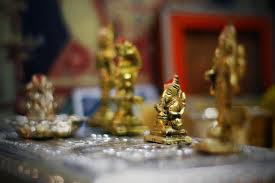 My aunt waves a pair of incense sticks in front of the deities, a gesture that conveys our respect and denotes that the Lord is ‘all light’. The burning of camphor symbolizes the melting of the ego, allowing the individual to shed connections to the material world and join the spiritual one. We offer sweets, rice, and fruit to the figurines staring back at us. The flickering of the light makes it seem like the faces are moving, that their lips are trying to tell us something. But I know better now. My aunt places the small dots of red paste on the foreheads of all the children; we will be called ‘children’ until there is no one left to call us that.
For the last prayer of the ceremony, we are meant to stand. The cousins hoist their mother from the floor so she doesn’t strain her back. Together, we begin uttering the Gayatri Mantra, which comes from the Rig Veda, one of the most ancient and sacred Hindu texts. We sing: Om bhur bhuvahh svah, Tat savitur varenyam, Bhargo devasya dhimahi, Dhiyo yo na prachodayat. “Let us concentrate on attaining fulfillment and strive for the dawning of the highest consciousness.”
 I belt out this prayer and start riffing on the melody like a member of the church choir. This prayer has been committed to memory, for I used to sing this with my sisters and grandfather every evening before dinner. I cannot recite the words on their own; yet, as soon as a group starts singing, the lyrics magically return to me. They are imprints made in sand that somehow managed to stick.
 The Memory Canon
Our different geography makes us unlike our parents in many things, but they have definitely engrained in us many things from their homeland. That makes us unique. Love your piece. Waiting for the next. 😉
It’s hard to find your blog in google. I found it on 20 spot,
you should build quality backlinks , it will help you to get more visitors.
I know how to help you, just search in google – k2 seo
tricks